
For banks and NBFCs, collections at scale is an operational problem before it is anything else.
A collection team may be managing thousands — or lakhs — of borrower accounts across every stage of repayment. Some borrowers just need a reminder. Some intend to pay on a specific date. Some have already paid. Some need a payment option. A few genuinely need a collection executive.
So the real question is not “how do we contact more borrowers?” It is:
How do we identify what each borrower needs, take the right next action automatically, and involve the collection team only when human intervention is actually required?
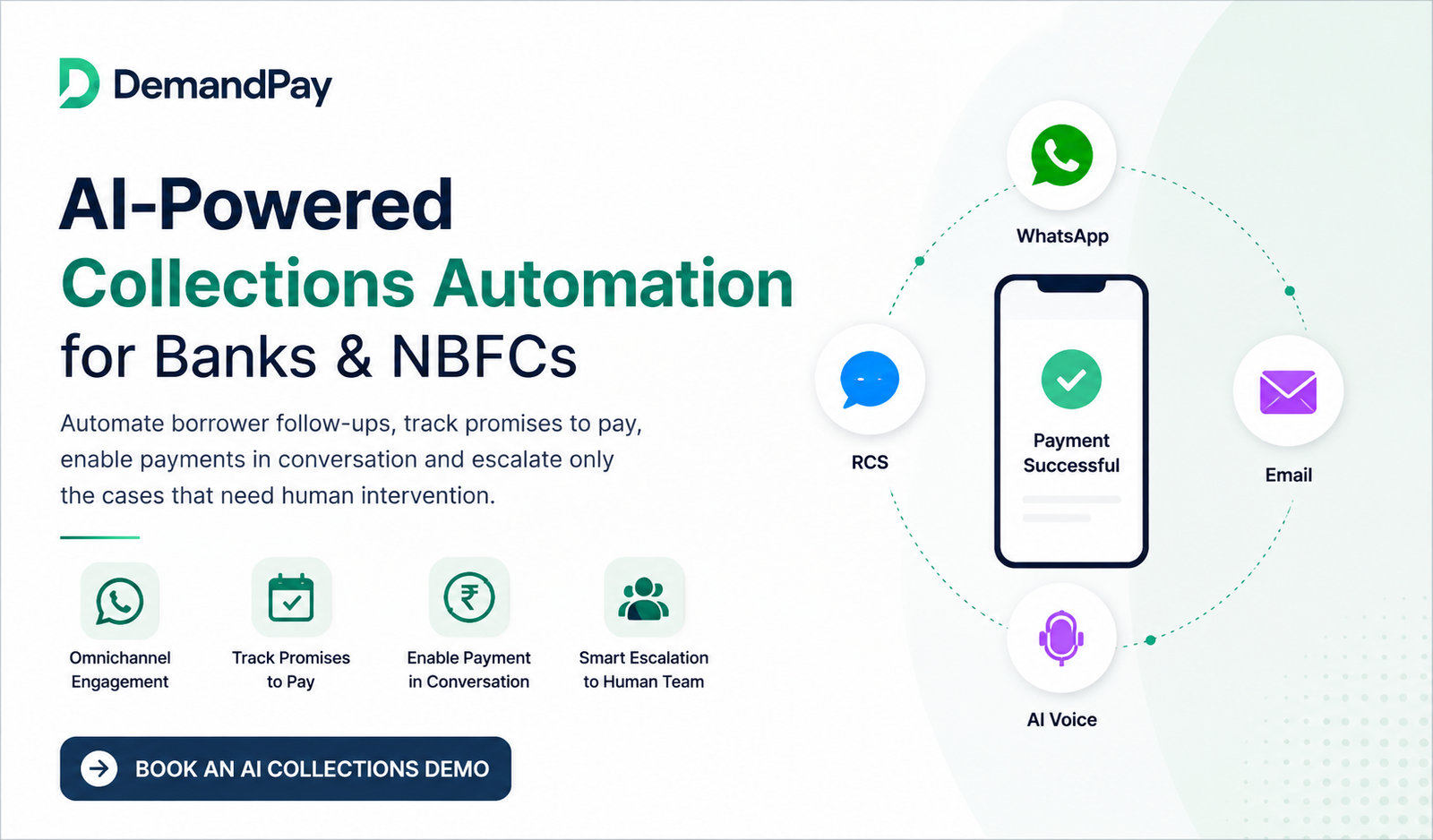
That is the job of AI-powered collections automation. DemandPay's AI-powered collections layer engages borrowers across WhatsApp, RCS, email and AI voice, understands their responses, tracks Promise-to-Pay commitments, enables digital payments, monitors payment status and escalates exceptions to your team.
Automate the routine layer of collections. Reserve human effort for exceptions.
What Is AI-Powered Collections Automation?
AI-powered collections automation combines AI, communication workflows and digital payment infrastructure to run the repetitive parts of the borrower collection journey automatically. An automated collections workflow:
- Sends payment reminders, due-date and overdue notifications
- Engages borrowers across multiple channels
- Understands borrower responses and identifies intent
- Captures and tracks Promise-to-Pay commitments
- Brings payment options into the collection journey
- Tracks payment status and stops follow-ups once payment is received
- Escalates unresolved cases to human teams
The objective is not to automate every collection conversation. It is to automate the routine layer so collection professionals spend their time where judgment, negotiation or intervention actually matters.
Soft collections — pre-due reminders, due-date notifications, early overdue follow-ups, payment links and PTP tracking — are the natural starting point, because early-stage activity is high-volume and repetitive. The larger opportunity is a connected, intelligent collection layer:
Borrower Data→Communication→Conversation→Promise-to-Pay→Payment→Reconciliation→Escalation
Why Traditional Collections Break at Scale
The math is the problem. A collection executive can work through only so many calls in a day, while a growing loan book adds accounts faster than any team can dial. The manual process — loan system to spreadsheet to call to reminder to follow-up to status update to payment verification — is familiar, and it collapses under volume.
Look at where team capacity actually goes:
- Calling borrowers who only needed a reminder
- Re-sending the same payment communication
- Recording commitments manually and tracking PTP dates in spreadsheets
- Checking whether borrowers have paid — and chasing borrowers who already have
- Updating status across systems instead of working accounts that need attention
As the portfolio grows, repetitive activity consumes the team. Automation inserts an intelligent workflow between borrower data, communication, payments and human intervention — so collection headcount doesn’t have to grow in lockstep with the loan book.
How AI-Powered Collections Automation Works
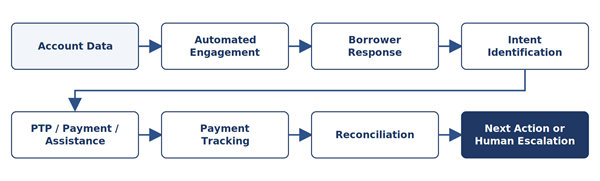
Instead of treating every borrower identically, the workflow decides the next action from each borrower's response and payment status.
1. Automated borrower reminders
Reminders are the most repetitive activity in collections. DemandPay triggers them from account status and your configured collection rules — without requiring an executive to initiate every reminder manually.
“Your EMI payment is due on 15 August. You can complete your payment using the option below.”
Right borrower. Right message. Right time. Consistently, across the entire book.
2. Omnichannel borrower engagement
Not every borrower responds on the same channel. One replies on WhatsApp within minutes; another reads email; some situations need a voice conversation. DemandPay moves the journey across WhatsApp, RCS, email and AI voice — in the sequence you configure — instead of relying on repeated outbound calling.
3. Understanding what the borrower says
Sending the reminder is the easy part. The value is in what happens after the borrower responds:
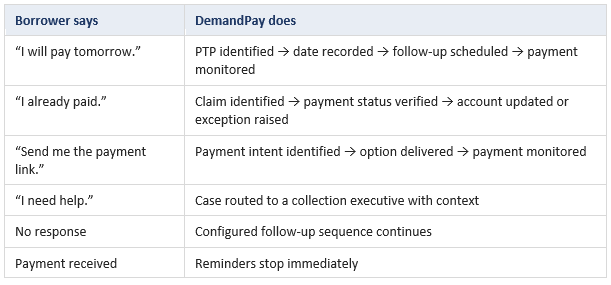
AI converts borrower conversations into structured collection actions — reducing manual interpretation and the risk of missed commitments.
4. Promise-to-Pay tracking
“My salary comes on Friday. I will pay then.” That sentence is a commitment, not just a chat message. DemandPay captures the PTP date, schedules the follow-up, monitors the payment and flags the account when a promise is missed.
Commitment→PTP captured→Follow-up scheduled→Payment monitored→Fulfilled or escalated
Your team gets live visibility into commitments across the book — not scattered notes in spreadsheets.
5. Payment inside the conversation
Every step between “I'll pay” and payment completed creates friction. DemandPay brings the payment option directly into the collection conversation, reducing the steps between borrower intent and payment completion. Payment status can then flow back into the workflow to determine the next action.
Reminder→Payment Option→Payment→Confirmation
6. Knowing when to stop
The worst borrower experience in collections is a reminder after payment. DemandPay tracks payment status and stops the sequence the moment the objective is achieved. If a borrower says “I already paid,” the workflow verifies the claim instead of repeating itself. A good collection system knows when to communicate — and when to stop.
7. AI voice in the collection journey
Text does not reach every borrower. AI voice handles reminders, due-date notifications, PTP capture and payment assistance as a native channel in the same workflow:
AI Voice: “Your EMI payment is currently due. Would you like the payment option sent to your WhatsApp?”
Borrower: “I'll make the payment on Thursday.”
The commitment is recognized, the PTP date recorded and the next action scheduled — exactly as on any other channel.
8. Escalating the right cases to human teams
Some interactions are better handled by people — including negotiation, disputes, hardship conversations and complex exceptions. DemandPay routes those cases to your collection team with the relevant conversation context.
AI handles volume. Humans handle exceptions.
Manual Collections vs AI-Powered Collections
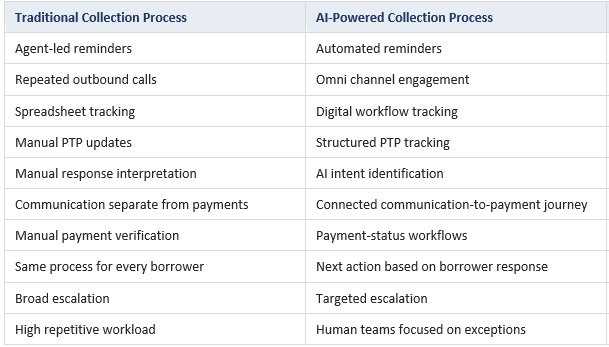
The biggest gain is not automation for its own sake. It is prioritization: your team's effort lands only where it creates value.
How DemandPay Automates Collections for Banks & NBFCs
DemandPay is an AI-powered collections layer that connects borrower communication, AI-driven workflows, digital payments and human escalation into one journey:
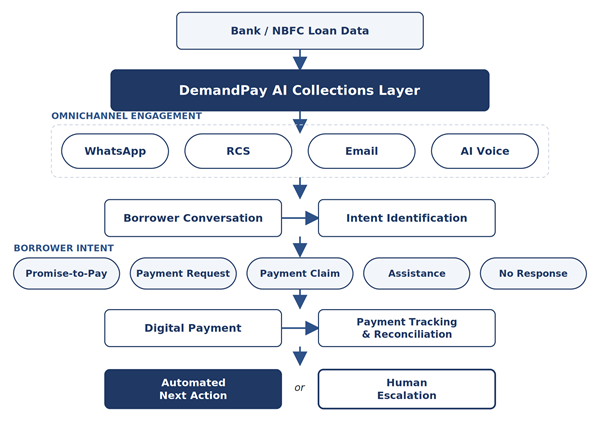
Key capabilities:
- Omnichannel engagement — WhatsApp, RCS, email and AI voice in one configurable journey.
- Automated follow-ups — reminders and sequences driven by account status and your collection rules.
- Borrower intent understanding — responses classified and converted into the right next action.
- Promise-to-Pay management — commitments captured, monitored and escalated when missed.
- In-conversation payments — borrowers can move from the collection message to a payment option with fewer steps.
- Payment tracking & reconciliation — transaction status decides whether communication continues, stops or needs verification.
- Intelligent human escalation — exceptions and unresolved cases routed to your team with context.
Engage→Understand→Promise→Collect→Track→Reconcile→Escalate

Why Early-Stage Collections Is the Right Place to Start
Early buckets are high-volume and repetitive: most borrowers need a reminder, a payment option, a follow-up on a commitment or a confirmation. That is precisely the work automation does best — and precisely the work that exhausts human teams. Automate it, and your collection professionals concentrate on the accounts where judgment creates value.
Compliance-First Collections Automation
Collection activity in India operates within a defined regulatory environment. RBI requirements and conduct expectations around recovery activities — including borrower privacy, non-harassment, appropriate communication practices and contact hours — must form part of a lender's collection process.
Automation should strengthen that discipline, not dilute it. DemandPay workflows can be configured around the lender's communication policies, permitted contact windows, channels, escalation rules and human-intervention points. This can make borrower interactions more systematic, consistent and auditable while maintaining appropriate human oversight.
What to Look for in an AI Collections Platform
- Omnichannel communication with borrower-response understanding
- Promise-to-Pay management
- Integrated digital payments and payment-status tracking
- AI voice as a native channel
- Reconciliation workflows
- Configurable escalation and human hand-off
- Collection reporting
- Security and compliance controls
The right platform fits into your existing collection process and removes repetitive work — it does not force a new process on your team.
Frequently Asked Questions
What is AI-powered collections automation?
It is the use of AI and automated workflows to manage borrower communication, reminders, responses, Promise-to-Pay commitments, payment journeys and escalation — end to end.
Can banks use AI for loan collections?
Yes. AI automates the repetitive layer of collections: reminders, borrower-response handling, PTP tracking, payment assistance and escalation. Human teams remain essential for complex cases and conversations requiring judgment.
Can NBFCs automate borrower follow-ups?
Yes. Borrower and account data connects to automated workflows that trigger reminders, capture responses, track payment commitments and escalate unresolved cases.
What are soft collections?
Early-stage borrower engagement — due-date reminders, payment follow-ups, Promise-to-Pay tracking and payment assistance — before more intensive collection action becomes necessary.
Can AI track Promise-to-Pay commitments?
Yes. The workflow identifies responses such as “I will pay tomorrow” and converts them into structured PTP records with dates, follow-ups and monitoring.
Can collections work through WhatsApp?
Yes — WhatsApp is one channel within an omnichannel collection workflow, used in line with the lender's communication policies and applicable platform and compliance requirements.
Can AI voice be used for collections?
Yes. AI voice handles reminders, payment conversations, Promise-to-Pay capture and escalation as a native channel in the collection journey.
Does AI replace collection agents?
No. The working model is division of labour: automation runs repetitive activity, while collection teams handle borrowers and cases requiring judgment, negotiation or assistance.
How does payment automation help collections?
It reduces the friction between a collection message and a completed payment. The borrower receives a payment option directly from the collection conversation, and the workflow tracks the resulting payment status.
What happens if the borrower says they have already paid?
The workflow verifies the payment claim against payment status instead of continuing the reminder sequence — and raises an exception if the claim does not match.
What happens when a Promise-to-Pay is missed?
The workflow triggers the configured follow-up or escalates the account to the collection team.
The Future of Collections: AI + Payments + Human Expertise
The question is not AI versus collection professionals. It is which activities technology should run, and which require human expertise. Routine reminders, response classification, PTP tracking, payment journeys and status-based follow-ups belong to automation. Complex accounts, exceptions and high-stakes borrower conversations belong to your people.
AI runs repetitive interactions.|Digital payments complete repayment.|Human teams handle exceptions.
Build a Smarter Collection Journey with DemandPay
If your collections still run on repeated outbound calls, spreadsheets and manual follow-ups, you are paying skilled people to do what a workflow does better — and pulling them away from the accounts that genuinely need them.
DemandPay brings borrower engagement, intent understanding, Promise-to-Pay tracking, digital payments, reconciliation and human escalation into one AI-powered collection journey.
Automate repetitive collections. Focus your team where it counts.
Vipin Kamal